Mind Mapping vs Note-Taking: When Each One Actually Wins
People love to ask whether mind mapping is “better” than note-taking, the way they ask whether a hammer is better than a screwdriver. It’s the wrong question. The right one is: what is this particular moment asking of you?
What linear notes are good at
Notes are sequential, and sequence is sometimes exactly right:
- Capturing things that arrive in order — a lecture, a meeting, a recipe, a process with real steps.
- Detail and nuance — full sentences, caveats, quotes. Maps compress; notes preserve.
- Speed of capture — when information is coming fast and you just need it down, linear is frictionless.
If the information has an inherent order and you mostly need to record it, take notes. Don’t force a map onto a thing that’s genuinely a list.
What mind maps are good at
Maps are spatial and relational, which wins whenever structure is the actual problem:
- Seeing relationships — how ideas connect, cluster, and depend on each other.
- Thinking before you know the order — brainstorming, planning, untangling. The order is the output, not the input.
- Getting the big picture — one glance shows the whole shape, which a 12-page note never will.
- Non-linear material — a knowledge domain, a project with interdependencies, a decision with branching consequences.
Notes answer “what was said?” Maps answer “how does it all fit together?” Most hard thinking is the second question wearing the costume of the first.
The move most people miss: use both
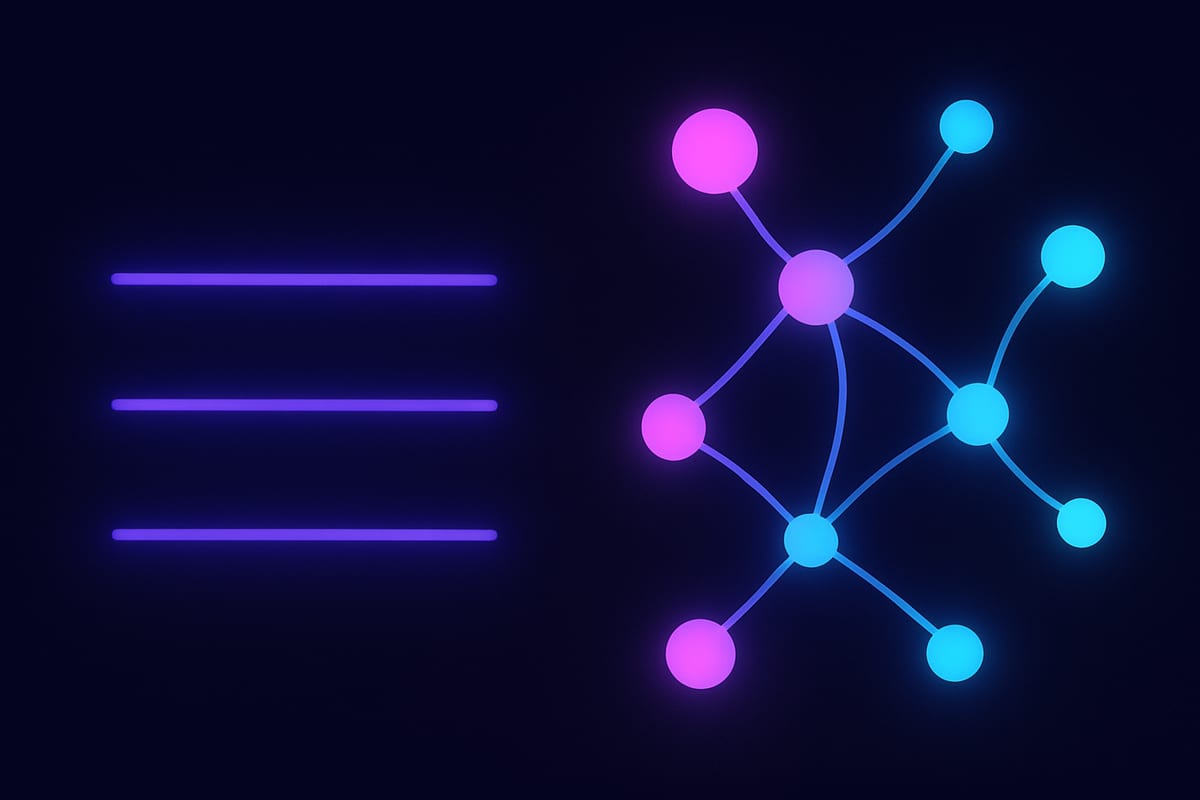
The strongest workflow isn’t choosing — it’s sequencing. Capture linearly, then restructure spatially. Take fast notes in the meeting or lecture. Afterwards, turn those notes into a map. The act of converting forces you to decide what relates to what, which is precisely the deep-processing step that flat notes skip. You end up with both: the detailed record and the structural understanding.
This is why SquishyMind supports Markdown, CSV, and OPML import. Your linear notes — from Notion, Obsidian, a Google Doc, wherever — come straight in, and the heading structure becomes a first-draft hierarchy you then reshape on the canvas. The capture stays fast and linear where it should be; the thinking gets spatial where it pays off.
A quick decision rule
Ask one question: do I already know the order? If yes — it’s a sequence, a process, a transcript — take notes. If no — if figuring out the order, the structure, or the connections is the work — make a map. And when in doubt, capture as notes and map afterwards. You’ll rarely regret doing both.
Try importing your notes into a map → Paste a Markdown outline and watch it become a canvas in one step. Free during beta.